
Despite at least 96 executions in Iraq this year and well-documented human rights abuses, the world remains silent
 Email
Email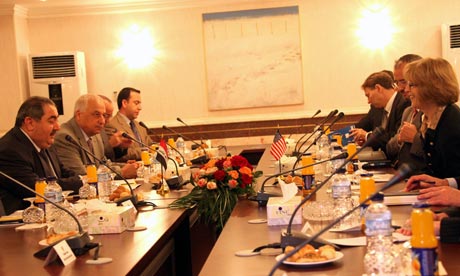
The US Iraq Joint Coordinating Committee gets underway. But is anyone mentioning human rights? Photograph: Mohammed Jalil/EPA
There
is also news of another 196 people on death row. According to Iraqi
officials, they have all
been
convicted on charges "related to terrorism," but there is little
information about their names, what crimes they committed or whether
they have access to lawyers or not. Amnesty International and Human
Rights Watch have previously documented the prevalence of unfair trials and torture in detention in
Iraq. Confessions under torture are often the only evidence against a
person who has been arrested following a secret informant's report.
Parading the accused with their tortured, empty looks on Al Iraqiya, the
official TV channel, is the norm. It took a court in Baghdad only 15
minutes to sentence Ramze Shihab Ahmed, a dual Iraqi-UK national, to 15 years' imprisonment after being found guilty of "funding terrorist groups".
Amnesty
has obtained and examined court documents and said it believes the
trial proceedings were "grossly unfair". Ahmed was held in a secret
prison near Baghdad, during which time his whereabouts were completely
unknown to his family. During this period Ahmed alleges he was tortured –
with electric shocks to his genitals and suffocation by plastic bags –
into making a false "confession" to terrorist offences.
So
what kind of human
rights are observed in the "new Iraq"? Hardly any. The list of abuses
is long and the tip of the iceberg is waves of arbitrary arrests (over
1,000 monthly), torture and executions. All are barely noticed by the
world media and the US and British official silence is rather convenient
to cover up the crimes and chaos they created.